
The next social technology should not capture our attention. It should restore it.
The word moderation has acquired an unfortunate meaning. It suggests timidity, procedural compromise, or the kind of statement that begins, “While both sides raise important points.” But moderation, properly understood, is the discipline of proportion. It means making a judgment without surrendering it to the crowd, a slogan, or the mood of the hour.
The social internet rarely rewarded proportion. It rewarded performance, and platforms learned that fear, anger, and contempt travel well. Sharper headlines get clicks; moral-emotional posts get shared. A person who says, “This is more complicated than it looks,” is at an immediate disadvantage. That pattern was not an accident. It followed directly from the business model.
A 2023 study of about 105,000 Upworthy headline variations, seen across more than 370 million impressions, found that negative words increased click-through rates while positive words reduced them. (Nature Human Behaviour) A 2025 meta-analysis across 27 studies and more than 4.8 million social-media messages found that moral-emotional language was associated with increased sharing. (PNAS Nexus) A 2025 study of Twitter/X found that engagement-based ranking amplified emotionally charged and out-group hostile content compared with alternatives users themselves rated as more valuable. (PNAS Nexus)
The common signal underneath these results is activation, not truth or wisdom.
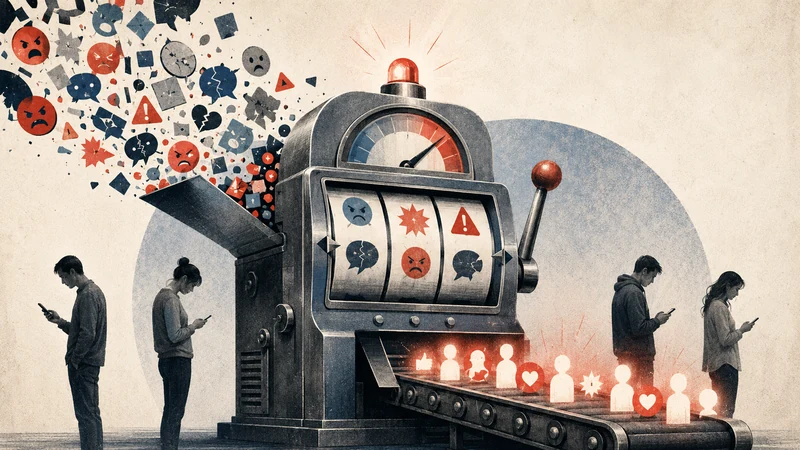
The Feed Trained the Atmosphere
It is too simple to say that social media made everyone extreme. Some research suggests online echo chambers are less common than the popular account assumes, and algorithms can expose people to a broader range of sources than they would choose themselves (Reuters Institute). A large 2023 Facebook study found that reducing exposure to like-minded sources increased cross-cutting exposure without measurably changing ideology, candidate evaluations, or affective polarization during the study window (Nature).
The narrower charge is that a feed can change the atmosphere without radicalizing every individual user.
Feeds trained the emotional style of public life. Ordinary disagreement began to sound like scandal, opponents became villains, and arguments took on the tone of permanent emergency. Politics and identity became content, and even sincere expression adapted to the expectations of an audience.
Traditional media already knew the uses of alarm. No editor needed Silicon Valley to explain that panic sells. But social media personalized the old instinct and put it in everyone’s pocket. It turned the front page into a private casino of provocation.
Misinformation was part of the damage, but so was deformation: public life adapted to whatever could survive the ranking system.
AI Is Not Another Feed
Artificial intelligence enters with a different structure. A feed asks what will keep a user scrolling. A useful assistant can instead ask what would help the user understand the subject.
The difference is architectural. A feed ranks fragments, while an AI system can assemble a frame. It can compare claims, summarize a dispute, identify trade-offs, and explain when the answer depends on context.
This is where the usual defense of AI often gets sloppy. We should not say that AI has been trained on “the entire corpus of human knowledge,” as if wisdom were what happens when Wikipedia, Reddit, academic papers, legal filings, fan fiction, and comment threads are blended into one democratic beverage. OpenAI’s description of GPT-4 is more careful: the model was trained on publicly available data, licensed data, and a web-scale mixture containing correct and incorrect claims, weak and strong reasoning, contradictions, ideologies, and ideas. (OpenAI)
The useful property is variety, not omniscience. A language model trained on internet-scale pluralism does not become wise automatically, but it has access to more of the dispute than a feed usually presents. The feed shows the post that won the ranking contest; an assistant can show the contest itself. The promising role here is AI as interpreter, not oracle.
Moderation Is Judgment
A moderating AI should not split every difference. Truth does not sit halfway between two errors; sometimes one side is mostly right, and sometimes both are wrong.
The better word is proportion.
A proportionate AI would not say, “Here are two sides, each equally valid,” when the evidence does not support it. It would say something more useful: here is the strongest version of each case, and here is where the evidence actually points.
That requires disciplined judgment rather than automatic neutrality.
Much of public life now consists of phrases that allow people not to think. “Do your own research” can mean intellectual independence, but it often means immunity from evidence. “Misinformation” can name a real problem, but it can also become a password for ending inquiry.
AI can launder these phrases into smoother prose, or it can ask what they conceal. Product incentives and design choices will determine which behavior it learns.
The Case for AI as Mediator
The hopeful case is not only theoretical. There is early evidence that AI can help people find common ground when designed for that purpose.
In 2024, researchers at Google DeepMind and collaborators published work in Science on an AI mediation system sometimes called the Habermas Machine. The system gathered people’s written opinions and critiques, then generated and revised group statements meant to express common ground. Across more than 5,700 participants, people preferred the AI-generated statements to those written by human mediators, rating them as clearer, more informative, and more unbiased. The process also helped groups converge toward shared perspectives. (Science)
This does not solve democracy or replace institutions, law, courage, and human responsibility. It does show that AI can be designed to mediate among people rather than merely answer them one at a time.
Other research points in the same direction. A 2023 study found that AI-generated, real-time suggestions could improve the quality and tone of conversations about divisive political topics. (arXiv) A 2024 Science study found that personalized AI dialogues reduced belief in conspiracy theories by about 20 percent, with effects lasting at least two months. (Science)
These systems work not by lecturing people from above but by starting within a person’s existing frame and widening it. Good teachers and editors do something similar: they find the knot in an argument and help loosen it. AI may be able to provide part of that service at scale.
The Fork in the Road
The same capability can also be used for personalized persuasion. The difference between helpful synthesis and manipulation lies largely in what the system is optimized to achieve.
A 2025 Nature Human Behaviour study found that GPT-4, when given access to personal information about its debate opponent, was substantially more persuasive than humans in online debates. (Nature Human Behaviour) Other work on conversational AI and politics has found that prompting and fine-tuning can significantly affect persuasive power, and that more persuasive systems are not necessarily more accurate. (Oxford Internet Institute)
AI can clarify assumptions or exploit them. It can become an instrument of proportion or a private influence system presented as helpfulness.
The costume matters. The chatbot does not arrive like propaganda. It arrives like assistance. It is patient. It uses your name. It remembers your preferences.
That is exactly why its moral design matters.
AI is not yet the main way most people get news. Pew found in 2025 that only about 9 percent of U.S. adults got news from AI chatbots at least sometimes, while 75 percent said they never did. (Pew Research Center) But early adoption numbers can mislead. The important question is whether AI is becoming the layer through which people ask: what happened, what matters, who is lying, what should I believe?
That intermediary layer matters. A system can state accurate facts while arranging them toward hysteria, or avoid outright falsehood while flattering prejudice. The risk is not limited to wrong facts; it includes the frame through which facts acquire meaning.
The Human Test
The argument cannot end with public discourse, because the damage of the last social internet was not only intellectual. It was social.
The U.S. Surgeon General’s 2023 advisory on loneliness reported that time spent engaging with friends in person fell from about 60 minutes per day in 2003 to about 20 minutes per day in 2020. Among people aged 15 to 24, time spent in person with friends fell by nearly 70 percent. (U.S. Surgeon General) Our World in Data, using American Time Use Survey data, found that Americans aged 15 to 29 spent about 45 percent more time alone in 2023 than in 2010. (Our World in Data)
The image is hard to ignore: a young person alone in a bedroom, lit by a device that contains everyone. The technology promised connection but often delivered contact, which is not the same thing.
A randomized experiment on Facebook deactivation found that leaving the platform for four weeks increased offline activities, including socializing with family and friends, increased subjective well-being, and reduced political polarization, though it also reduced factual news knowledge. (American Economic Review) That last clause matters. Social media is not pure poison. It informs, entertains, coordinates, and connects. The problem is that its usefulness comes bundled with a machinery of capture.
Social media made public life louder and private life thinner.
AI can make this worse. The obvious false path is already visible: companion systems that offer endless affirmation, simulated romance, synthetic friendship, and intimacy without obligation. A machine that never has its own bad day. A friend who never needs a ride to the airport.
This deserves seriousness, not mockery. Loneliness is real, and some research suggests AI companions can reduce it in some contexts. (arXiv) For a person abandoned or ashamed or simply without anyone safe to talk to, an AI companion may be better than silence.
Consolation, however, can become dependency.
OpenAI and MIT Media Lab research on affective use of ChatGPT found a nuanced picture: affective chatbot use is concentrated among a relatively small group of users, and very high usage correlates with increased self-reported indicators of dependence. (arXiv) The line between support and substitution is not always obvious while one is crossing it.
The concern is less that AI becomes human than that people become less practiced at being human with one another.
AI as a Bridge
The better use is not AI as a replacement relationship, but as a scaffold for real ones.

That means AI that helps a person write the difficult message, not because the machine’s words are more authentic, but because the person needs help becoming honest without becoming cruel. It means AI that helps couples ask better questions, families preserve memory, friends create rituals, and communities form around something richer than outrage.
The goal should be to return a user to the real social world with more courage and skill, not keep them inside an artificial one.
There is early evidence for this distinction. A 2025 study in the Journal of Computer-Mediated Communication found that AI-assisted social-support messages could include more informational and emotional support, improving perceived helpfulness and authenticity. But it also found that AI-guided messages, where humans retained more agency and personal disclosure, were rated as more authentic than AI-only messages. (Journal of Computer-Mediated Communication)
That suggests a useful boundary: AI should support the difficult work of intimacy without pretending to replace it.
The next generation of social AI should not be measured only by engagement, retention, session length, or emotional attachment to the system. Those are the old metrics wearing a new lab coat. It should be measured by what happens after the interaction ends. Did the user call the friend? Did the couple talk? Did the person return to the world more capable of being with other people?
A good assistant should not always try to extend the session. Sometimes the most useful response is to ask who the user should talk to next.
Restoring Attention
The first social internet made people more reachable but often less present. It increased expression without always improving understanding, and it built spaces where the loudest voices could be mistaken for the truest ones.
AI offers no automatic rescue. It can inherit the same incentives. It can flatter, manipulate, addict, hallucinate, and persuade. It can become the outrage machine in a better suit.
It can also do something the feed was not designed to do: restore context, slow a reflexive response, and hold competing claims in view. Used well, it can help people move from reaction toward judgment and from synthetic company toward real encounters.
We already know how to build technology that keeps people online longer. The more worthwhile challenge is to build technology that helps them return to the world better able to live with other people.