Why a smaller model + an academic corpus can outperform a larger model grounded with search
- Date: January 2026
- Author: Dominik Gorecki
Executive summary
My previous white paper showed that Gemini 3 Flash + domain RAG (academic psych/cog-sci corpus) significantly outperforms (1) Gemini 3 Flash without retrieval and (2) Gemini 3 Pro without retrieval on 4/5 judged dimensions, with coherence the only non-significant metric. (nikgo)
This new experiment tightens the baseline: Flash + domain RAG is compared against Gemini 3 Pro + grounded with search (a “web RAG” style system). The headline result holds: domain RAG still wins, with statistically significant improvements in overall_score and 4/5 dimensions (factual correctness, completeness, hallucination risk, academic response), while coherence remains not significant—but the effect sizes and win rate are weaker than when Pro had no retrieval, which is exactly what you’d predict when you add grounding to the larger model.
Abstract
Retrieval-Augmented Generation (RAG) is often treated as interchangeable with “grounding via web search,” but retrieval quality and corpus alignment should matter—especially for research-grade synthesis. We extend prior controlled experiments by comparing a smaller model (Gemini 3 Flash) using a domain-specific academic RAG corpus against a larger model (Gemini 3 Pro) grounded with search. Using blinded pairwise LLM-as-judge evaluation (ChatGPT 5.2 Thinking), randomized A/B ordering, and Wilcoxon signed-rank tests across five dimensions plus an overall score, we find statistically significant gains for domain RAG on overall_score and 4/5 dimensions (excluding coherence). The win rate drops from the earlier “Pro without retrieval” baseline to 86.7% wins / 6.7% ties / 6.7% harms (n=15), indicating that search grounding narrows—but does not close—the gap. These findings support a stronger systems claim: RAG is not one thing; for research tasks, domain-aligned corpora can beat general web grounding even on smaller models.
1. What’s new compared to the previous white paper
The previous paper established two results:
- Same model, retrieval matters: Flash + RAG > Flash without RAG. (nikgo)
- RAG can substitute for scale: Flash + RAG > Pro without RAG. (nikgo)
This third experiment asks the harder question:
If you give the larger model its own retrieval (search grounding), does the specialized academic corpus still win?
This is the important “real world” comparison, because many teams assume “Pro + web search” is effectively “best possible RAG.”
2. Background and related work
Recent work consistently finds that retrieval grounding can improve factual accuracy and reduce hallucinations, particularly for domain-specific or time-sensitive queries. (arXiv)
But the literature is equally clear on a second point: retrieval is not automatically beneficial. Whether retrieval helps depends on when you retrieve, what you retrieve, and how you integrate it. (aclanthology.org) This is where “search grounding” and “domain RAG” can diverge:
- Generic web retrieval can be broad, noisy, and uneven in academic rigor.
- Curated domain corpora can concentrate high-signal evidence and support more disciplined synthesis.
Methods like evidence refinement (condensing retrieval into key supporting evidence) improve consistency and answer quality, underscoring that retrieval quality/integration are first-class system components—not add-ons. (aclanthology.org) And large best-practice benchmarks show RAG outcomes are sensitive to configuration choices (prompting, chunk size, KB size, retrieval strategies). (aclanthology.org)
3. Experimental design
3.1 Tasks and corpus
- 3 research questions (psychology/cognitive science), 5 trials each → n=15 paired judgments.
- Domain RAG corpus: academic psych/cog-sci papers; 250,296 vectorized chunks (300–500 words).
3.2 Model conditions
- Answer X: Gemini 3 Flash + domain RAG (same RAG answers used in prior experiments)
- Answer Y: Gemini 3 Pro + grounded with search (web-grounded retrieval)
3.3 Evaluation protocol
- Judge: ChatGPT 5.2 Thinking
- Blinded pairwise A/B, randomized ordering
-
Metrics:
- overall_score
- factual_correctness
- completeness
- coherence
- hallucination_risk (lower risk = higher score)
- academic_response
- Statistics: Wilcoxon signed-rank test (two-sided) on paired differences vs 0.
4. Results
4.1 Headline: domain RAG still wins vs Pro + search grounding
Across all 15 evaluations:
- Win rate: 86.7% (13/15)
- Tie rate: 6.7% (1/15)
- Harm rate: 6.7% (1/15)
This is weaker than the earlier comparison against Pro without retrieval (expected), but still strongly favorable overall.
4.2 Overall metrics and significance (Wilcoxon)
Mean paired differences (Answer X − Answer Y), n=15:
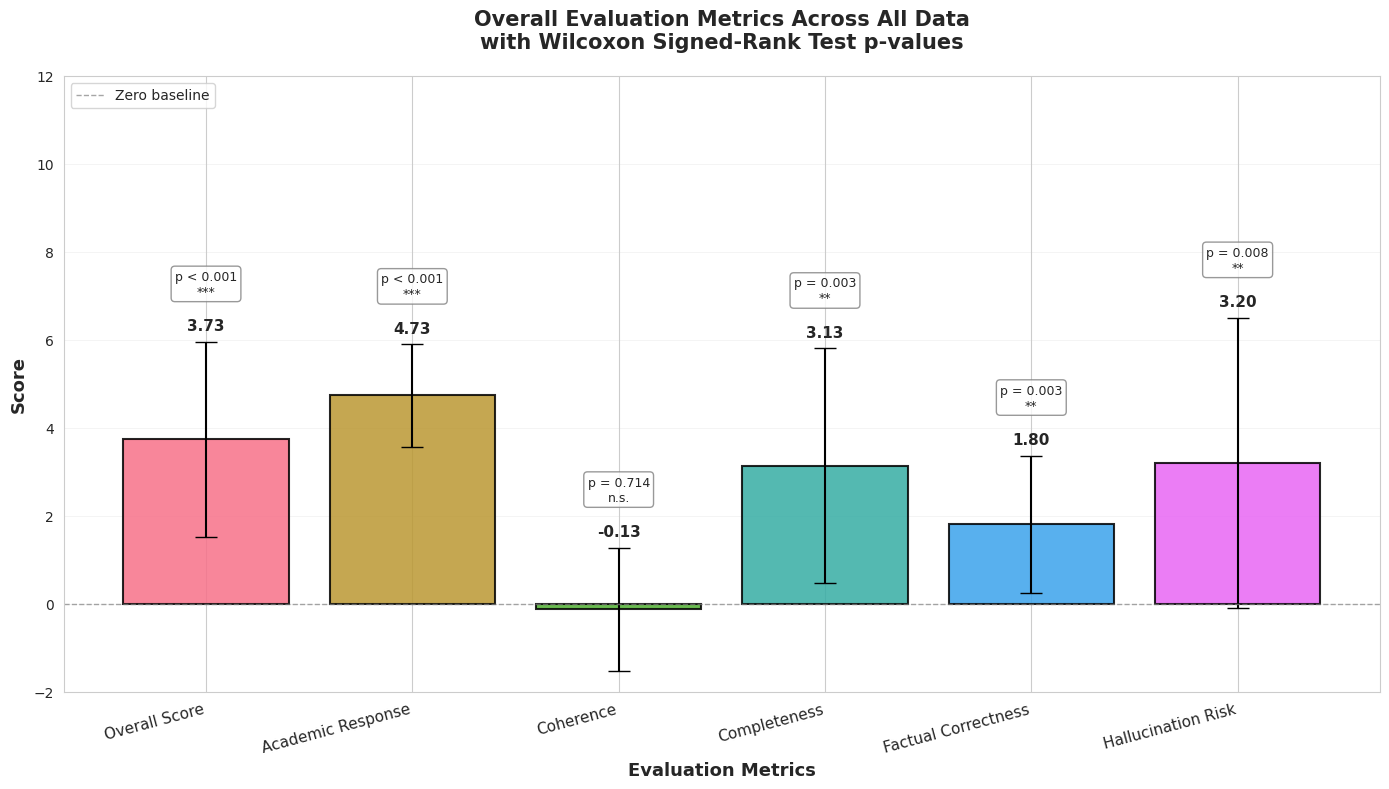
- Overall score: +3.73, p=0.0008 (***)
- Academic response: +4.73, p=0.0006 (***)
- Completeness: +3.13, p=0.0035 (**)
- Factual correctness: +1.80, p=0.0031 (**)
- Hallucination risk: +3.20, p=0.0080 (**)
- Coherence: −0.13, p=0.7139 (n.s.)
 Figure 1: Overall results bar chart — paired score deltas for overall_score + five dimensions, with significance markers
Interpretation: compared to “Pro without retrieval,” grounding Pro with search improves the baseline, shrinking the gap—but domain RAG still wins on the dimensions that matter most for research outputs: factuality, completeness, academic quality, and hallucination risk.
4.3 Coherence again: still not significant
Coherence remains non-significant, matching the prior paper’s result. (nikgo) This aligns with broader findings that retrieval can help or hurt depending on conditions and that integration is a system-design problem (selection, reranking, synthesis constraints), not a guaranteed byproduct of “having sources.” (aclanthology.org)
5. NLP analysis: domain RAG outputs are longer and more academic (and harder to read)
Compared to Pro + search grounding, domain RAG outputs are:
- Much longer: +3895 characters on average (p=0.0001)
- Denser: more sentences and longer sentences (both significant)
- More complex: lower Flesch Reading Ease and higher grade-level indices (all p=0.0001)
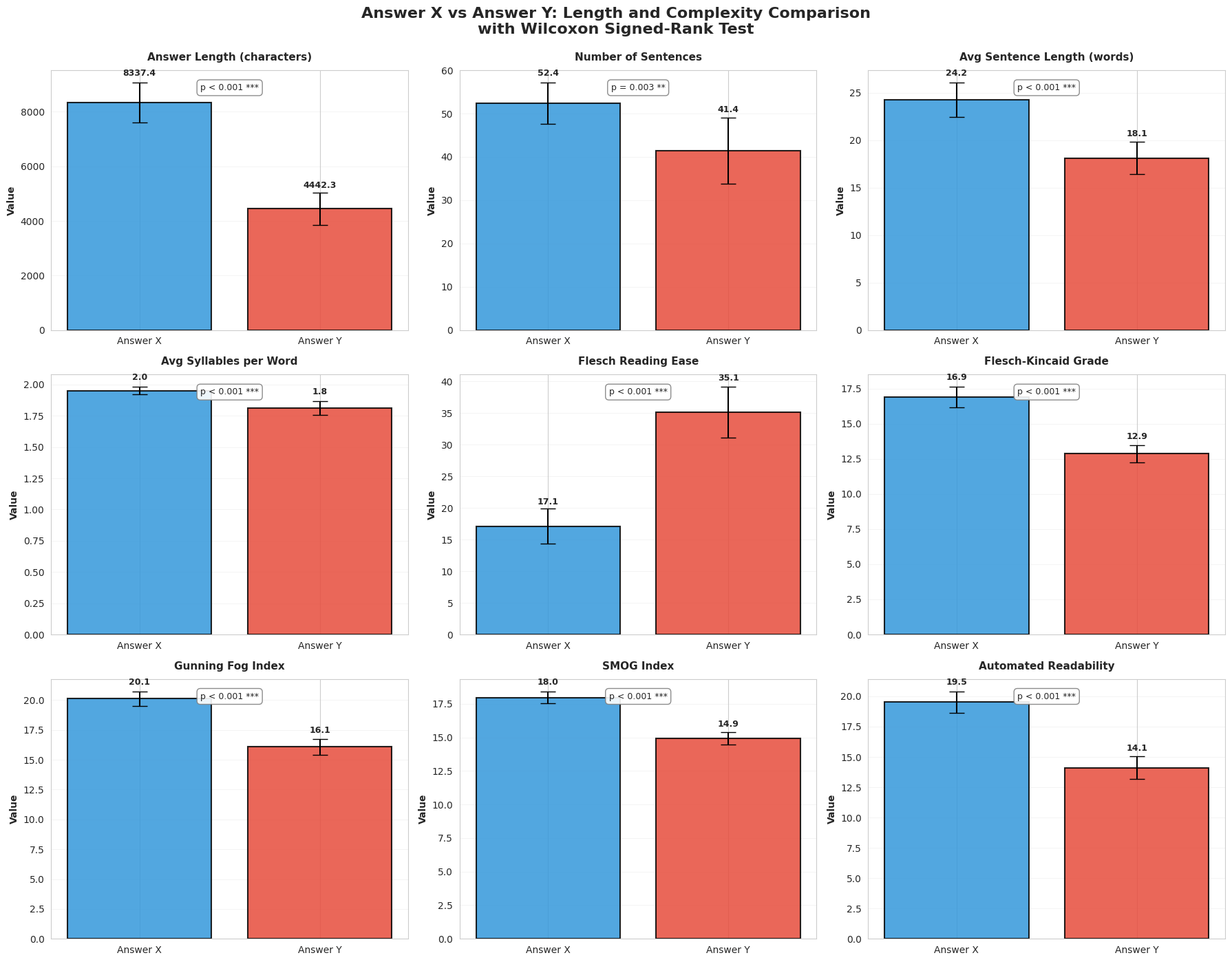 Figure 2: Readability + length comparison panel (Answer X vs Answer Y)
This trade-off is consistent with what you’d expect: when you retrieve from an academic corpus, the model tends to produce more qualified, terminology-rich synthesis. Similar effects appear in applied retrieval-grounded systems that prioritize evidence-driven reliability over readability. (jmir.org)
6. Why domain RAG can beat “search grounding”
This experiment is basically a referendum on corpus alignment.
Search grounding is retrieval, but it’s retrieval from an open, heterogeneous corpus with:
- variable rigor,
- inconsistent terminology,
- and uneven incentives (SEO vs scholarship).
A domain academic corpus is:
- higher signal-to-noise for research questions,
- more conceptually coherent,
- and better aligned with what the judge rewards as “academic response.”
The research community’s “retrieval helps or hurts” results predict exactly this: if retrieval quality is noisy or mismatched, you don’t automatically get better synthesis—sometimes you just get more clutter. (aclanthology.org) And the best-practices / refinement line of work essentially says: you win when your retrieval system produces the right evidence and you integrate it cleanly. (aclanthology.org)
7. Practical implications for AI teams
7.1 Don’t treat “RAG” as a checkbox
This study supports a stronger framing: RAG is an architecture class, and corpus choice is a primary driver of outcomes. (aclanthology.org)
7.2 When Pro + search is “good enough”
If your task is:
- broad, current events,
- product comparisons,
- rapidly changing facts, then web grounding can close much of the gap.
7.3 When domain RAG wins (even on smaller models)
If your task is:
- research synthesis,
- academically constrained domains,
- high-cost hallucination settings, then a curated corpus can outperform generic search grounding. This matches evidence from domain-focused retrieval grounding work showing improved accuracy/reliability when grounded in a relevant curated literature base. (arXiv)
7.4 Recommended “research mode” pipeline
- Retrieve from domain corpus (plus optional web for recency)
- Rerank + deduplicate
- Evidence refinement (KSE-style condensation)
- Synthesis with structure constraints
- Final “clarity pass” rewrite (to fix readability without losing substance)
This mirrors the direction of recent refinement/best-practices research. (aclanthology.org)
8. Limitations
- Only three prompts (n=15 judgments); broader domains needed.
- LLM-as-judge is scalable but should eventually be triangulated with human evaluation.
- The Pro+search system’s retrieval behavior may vary with query formulation; “search grounding” isn’t a single fixed method.
9. Conclusion
Adding search grounding to Gemini 3 Pro improves the baseline and reduces the gap versus domain RAG—but a smaller model with a domain-aligned academic corpus still wins, with statistically significant improvements in overall_score and 4/5 judged dimensions. The result generalizes the core thesis from the prior paper: retrieval can substitute for scale—and now adds a sharper point: retrieval quality and corpus alignment can beat generic web grounding for research tasks. (nikgo)
References
- Gorecki, D. (2026). Retrieval-Augmented Generation as a Capability Multiplier for Research Tasks. nikGo. (nikgo)
- Jin, J., Zhu, Y., Zhou, Y., & Dou, Z. (2024). BIDER: Bridging Knowledge Inconsistency for Efficient Retrieval-Augmented LLMs via Key Supporting Evidence. Findings of ACL 2024. (aclanthology.org)
- Kozhipuram, A. V., Shailendra, S., & Kadel, R. (2025). Retrieval-Augmented Generation vs. Baseline LLMs: A Multi-Metric Evaluation for Knowledge-Intensive Content. Information, 16(9), 766. (MDPI)
- Li, J., Yuan, Y., & Zhang, Z. (2024). Enhancing LLM Factual Accuracy with RAG to Counter Hallucinations: A Case Study on Domain-Specific Queries in Private Knowledge-Bases. arXiv:2403.10446. (arXiv)
- Li, S., Stenzel, L., Eickhoff, C., & Bahrainian, S. A. (2025). Enhancing Retrieval-Augmented Generation: A Study of Best Practices. COLING 2025. (aclanthology.org)
- Maekawa, S., Iso, H., Gurajada, S., & Bhutani, N. (2024). Retrieval Helps or Hurts? A Deeper Dive into the Efficacy of Retrieval Augmentation to Language Models. NAACL 2024 (Long). (aclanthology.org)
- Xu, S., Yan, Z., Dai, C., & Wu, F. (2025). MEGA-RAG: A retrieval-augmented generation framework with multi-evidence guided answer refinement for mitigating hallucinations of LLMs in public health. Frontiers in Public Health, 13. (Frontiers)
- Li, H., Huang, J., Ji, M., Yang, Y., & An, R. (2025). Use of Retrieval-Augmented Large Language Model for COVID-19 Fact-Checking: Development and Usability Study. JMIR, 27, e66098. (jmir.org)