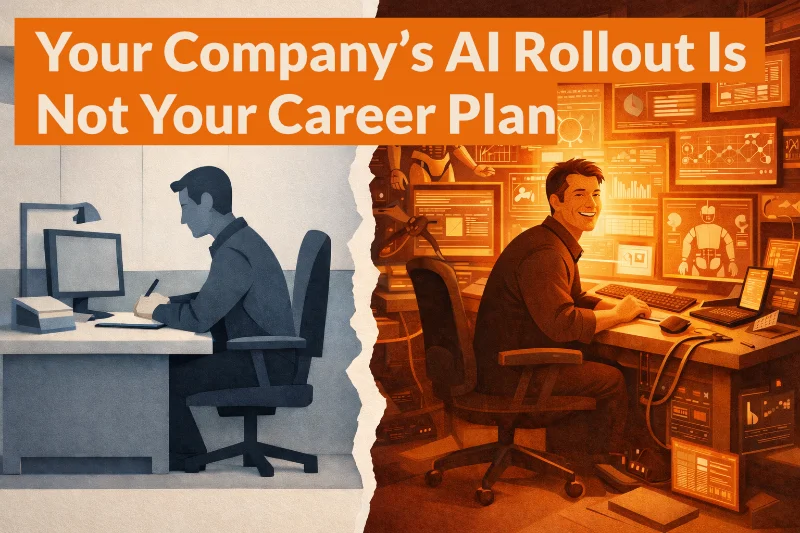
Two engineers at the same company receive access to the same approved AI assistant. One uses it occasionally in the IDE and considers that enough. The other experiments outside work with several tools on side projects, scripts, local automations, and disposable repositories. She sees how agents plan, drift, fail, recover, and produce convincing nonsense. After six months, the two engineers may have access to the same technology, but they have not developed the same skill.
That difference matters in 2026. The engineers pulling ahead are not necessarily those whose employers bought access first. They are the ones building a practice before their organizations finish standardizing one.
Adoption is not the same as mastery
Whether AI matters for software development is no longer an interesting debate. The better question is what kind of developer emerges from widespread adoption.
Stack Overflow’s recent data makes the shape of the moment plain. More than 84 percent of developers say they are using or planning to use AI tools. In the 2025 results, 80 percent said they were already using AI tools in their workflows, but trust in those tools had fallen to 29 percent. Sixty-six percent said they were spending more time fixing “almost-right” AI-generated code, and 75 percent said that when they do not trust the answer, they still ask another person. (AI | 2025 Stack Overflow Developer Survey, Mind the gap: Closing the AI trust gap for developers)
Adoption has gone mainstream faster than judgment. Tools are widely available, but the craft of using them well is not. Light exposure, a lunch-and-learn, and an approved plugin amount to access, not training.
Your employer is not your training program
Companies adopt AI around governance, procurement, privacy review, and agreement among stakeholders. That is rational, but those priorities do not amount to a curriculum for individual mastery.
Enterprises tend to centralize around one approved model, memory layer, and workflow. In an earlier article on BYOAI, I described the larger version of this tendency as the “central brain” company: an institution that wants talent to compound while keeping ownership of the compounding engine. A better alternative is portable augmentation—a personal system of context, judgment, and workflow that can move with the worker—within clear boundaries for company data and intellectual property (THE 2028 INTELLIGENCE EXPLOSION).
Junior engineers need the practice because they are still developing taste. Mid-career engineers need it to turn experience into leverage. Senior engineers need it because delegating the learning to younger colleagues eventually leaves them managing work they no longer understand firsthand.
Build a personal stack
The right move for many engineers is not to buy one extravagant premium plan and declare victory. It is to widen the learning surface. Several of the major products already have free or accessible individual tiers. Gemini Code Assist for individuals is available at no cost. Cursor has a free Hobby tier and a $20 Pro plan. Claude’s Pro plan is $20 a month. Codex is included across the main ChatGPT paid lineup and, for now, also appears in Free and Go on a limited basis. (Gemini Code Assist overview, Cursor Pricing, Choosing a Claude plan, Using Codex with your ChatGPT plan)
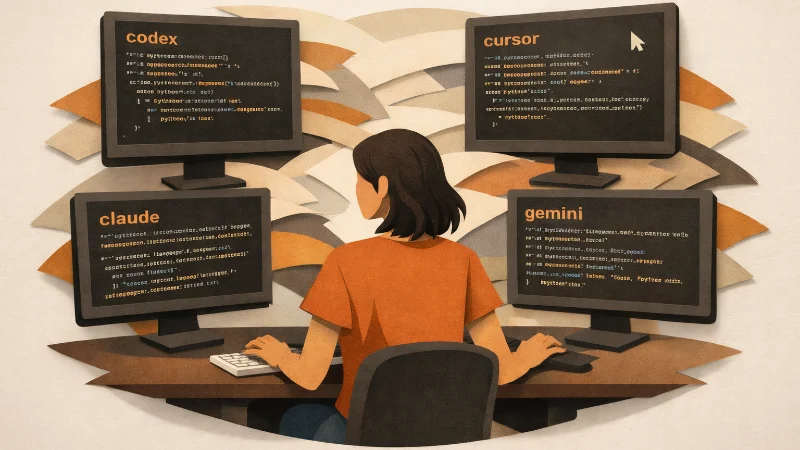
If I were building a personal stack now, I would use Claude, Cursor, Codex, and Gemini in parallel on real work. The goal is not to produce a universal leaderboard. It is to develop firsthand judgment about where each tool helps and where it gets in the way.
Claude matters because Claude Code is a clear example of codebase-native agentic work: it reads your codebase, edits files, runs commands, and works across terminal, IDE, desktop, and browser. Cursor matters because it shows what happens when the editor itself becomes an agentic environment; its pricing page now reads like a map of the new terrain, with cloud agents, skills, hooks, and frontier models. Codex matters because OpenAI has turned it into a more explicit command center for parallel work with worktrees, automations, Git functionality, and skills. Gemini matters because Google has pushed it toward agent mode and now exposes Gemini CLI as an open source terminal agent with MCP support and a ReAct loop. The point of using all of them is to understand how they differ, where they overlap, and how fast the ground is moving under each of them. (Claude Code overview, Cursor Pricing, Codex app, Gemini Code Assist release notes, Gemini CLI)
Comparative use teaches you what each tool is good at, how much structure it needs, and when switching is worth the interruption.
Stop chatting with the tools
Paying for several subscriptions is still just consumer behavior. Skill develops when you use the systems to build and maintain something: a development-environment bootstrap, a small app with tests and CI, a repository-maintenance bot, a bug-triage workflow, or a local utility. The project need not be important. It does need enough consequence to force you through the entire idea-to-shipping loop.
This is also where the products themselves are telling you what the market is becoming. Claude Code is built to read files and run commands. Codex is organized around worktrees, automations, Git, and reusable skills. Google’s agent mode and Gemini CLI frame the tool as something that can plan, act, and use connected systems. Taken together, the product direction points away from “better autocomplete” and toward orchestration. (Claude Code overview, Codex app, Gemini Code Assist release notes, Gemini CLI)
Borrowed prompts do not compound
This advice is often flattened into a list of prompts, a folder structure, and a supposedly definitive workflow. Those borrowed artifacts can help someone start, but they do not replace personal patterns developed through use.
Anthropic’s docs make the logic visible. Some built-in commands are explicitly marked as Skills, and the company says they use the same mechanism as the skills users write themselves. OpenAI’s Codex docs make the same point in a different vocabulary: use AGENTS.md for durable guidance, use skills for repeatable workflows, and correct recurring mistakes so the correction persists. (Commands - Claude Code Docs, Best practices – Codex)
The durable asset is a private working system of repository primers, planning commands, review rubrics, model-routing habits, debugging templates, and verification gates shaped by your own successes and failures. Copying someone else’s setup gives you their conclusions without the judgment that produced them.
Judgment is the scarce skill
Generation is getting cheaper and more available by the quarter. Judgment is not.
The trust data points there, and so do the vendor docs. Anthropic’s own guide says the highest-leverage move is giving Claude a way to verify its work. Google warns users to validate Gemini Code Assist output because it can still generate incorrect information. (Mind the gap: Closing the AI trust gap for developers, Best Practices for Claude Code, Gemini Code Assist overview)
The useful engineer is the one who notices when an agent has misunderstood the repository, proposed an overambitious plan, trusted misleading tests, suggested a dangerous command, or produced plausible but wrong code—and who knows when to stop delegating and think.
OpenClaw is graduate school
OpenClaw belongs later in this progression. It is most useful after you have built competence with ordinary coding agents and want to examine what changes when an agent can act beyond the editor and terminal at the operating-system level.
The repo describes OpenClaw as a personal AI assistant for any OS. Its own security guidance is even more revealing. OpenClaw says its model is a one-user trusted-operator setup, not a shared multi-tenant boundary. Anthropic’s computer-use documentation carries a similar warning label in plainer language: review every action and log, and keep these systems away from precision-critical or sensitive tasks unless a human is supervising. That is not boilerplate. It is the frontier telling you what it is. (OpenClaw Personal AI Assistant, OpenClaw Security Overview, Computer use tool)
There is also a strategic lesson hidden in the recent OpenClaw billing story. TechCrunch reported on April 4 that Anthropic told subscribers they could no longer use normal Claude subscription limits for third-party harnesses such as OpenClaw and would instead need separate pay-as-you-go usage. Even if you never touch OpenClaw, the message is obvious enough. Platform rules change. Access models change. The more your learning depends on a single vendor’s assumptions staying still, the more fragile that learning becomes. (Anthropic says Claude Code subscribers will need to pay extra for OpenClaw usage)
Experiment in non-sensitive environments, isolate accounts, and avoid production systems. An OS-level agent belongs in a lab before it belongs anywhere consequential.
Stop waiting for permission
This is not an argument for turning every evening into unpaid training for a future employer. It is an argument that passive exposure through a corporate rollout is insufficient while the tools are changing this quickly and so much leverage depends on personal judgment.
Use the company seat for company work. Outside it, build a modest practice that belongs to you. Try a few personal tools, build one small system, invent a workflow that did not come from a template, and keep notes on what worked. You learn more when the task, machine, mess, and final judgment are yours.
The important divide is not AI users versus non-users, or early adopters versus skeptics. It is between engineers building portable judgment and those relying entirely on what their current institution provides. A company can standardize a tool; it cannot build that judgment on your behalf.
References
- AI | 2025 Stack Overflow Developer Survey
- Mind the gap: Closing the AI trust gap for developers
- Claude Code overview
- Best Practices for Claude Code
- Codex app
- Commands - Claude Code Docs
- Best practices – Codex
- Gemini Code Assist overview
- Gemini Code Assist release notes
- Gemini CLI
- Cursor Pricing
- Choosing a Claude plan
- Using Codex with your ChatGPT plan
- THE 2028 INTELLIGENCE EXPLOSION
- OpenClaw Personal AI Assistant
- OpenClaw Security Overview
- Computer use tool
- Anthropic says Claude Code subscribers will need to pay extra for OpenClaw usage