What a conversation about The Gentlemen revealed about art, abundance, and the things we may not want to automate.
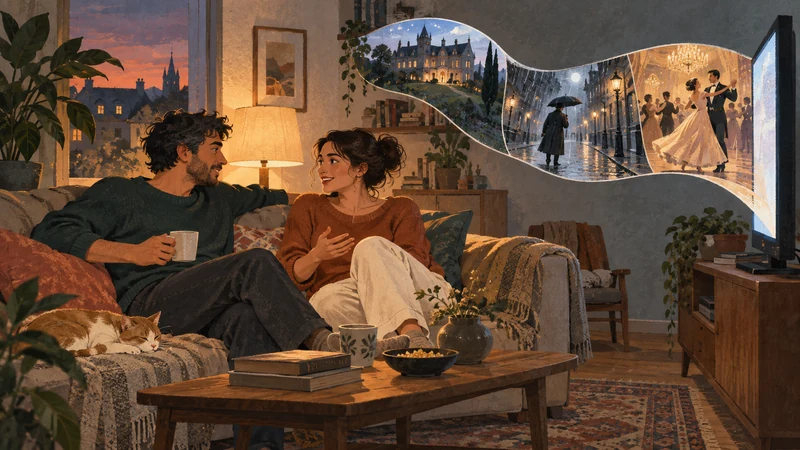
My wife and I finished a season of The Gentlemen in five days. I responded to this thoroughly enjoyable experience by proposing an industrial expansion.
In the future, I told her, Guy Ritchie could use generative AI to make hundreds of episodes a season.
Hundreds! A practically inexhaustible supply of elaborate criminal misunderstandings. We could spend the rest of our lives watching beautifully dressed people make catastrophically poor decisions about money. No waiting for another production cycle. No running out just as we had developed a healthy emotional dependence on the merchandise.
My wife was not immediately delighted.
She would not be interested, she said, in watching a show made by generative AI. It would lack the human element.
I understood. My first instinct was much the same. A machine autonomously manufacturing a television series might be fascinating initially, in the way a toaster delivering a competent wedding speech would be fascinating. But after the technological astonishment wore off, would I care?
I thought I had a distinction that would settle this.
Not a show made instead of Guy Ritchie. A show made by Guy Ritchie, using AI.
The human element! There he was! An actual human, conveniently supplied with a name and an established body of work. Surely this settled the paperwork.
It did not.
My wife found that version more appealing. But she still felt a stronger affinity for a show made through the conventional human process: people acting, filming, editing, working together to produce something.
We never settled the question. But her hesitation left me wondering:
When we say we value the human element, which human element do we mean?
A director, finally rid of his production
My argument had a certain intoxicating simplicity.
Imagine giving a filmmaker something closer to the freedom of a novelist. A novelist can introduce a ballroom, a thunderstorm, an army, or a minor character with an exceptionally expensive face without first assembling a financing package. The world can expand at the speed of a sentence.
With a sufficiently capable generative system, Ritchie might work with moving images much as a novelist works with words. He could shape a scene, revise a performance, change the setting, reject twenty versions, discover something unexpected in the twenty-first, and keep working until it felt right.
Not a button labelled MAKE GOOD TELEVISION. A medium through which he could make television.
Speed was part of the attraction. So was the possibility of getting closer to what he imagined. Perhaps some stories could become more personal precisely because they required less money, less permission, and fewer logistical miracles to exist.
There are already examples of this kind of authorship. Eliza McNitt’s 2025 short film Ancestra, inspired by the circumstances of her own birth, combined live action with AI-generated sequences. Google DeepMind’s production account describes her writing the script and developing the imagery with artists and technologists. It also reports collaboration with more than 200 traditional filmmaking and production experts. This is a technology supplier’s account, not an independent verdict on artistic quality. Even with that caveat, it shows how little the label “AI-made” tells us about the work (Kory Mathewson).
“AI-made” might describe a filmmaker using new tools to pursue an intensely personal project. It might also describe a system automatically producing disposable entertainment while everyone involved checks the engagement statistics.
These are not the same activity.
Putting Ritchie’s name on the automated entertainment would not settle the question of authorship. He would have to be involved: making decisions and revisions, committing to choices that expressed his particular sensibility.
I wanted to make human expression more direct. My wife wondered whether we might remove something worth having along the way.
The human element has several departments
Consider a love letter.
Suppose my wife writes me a letter expressing something she has struggled to say. Now suppose an automated system produces exactly the same words without her involvement or knowledge.
The adjectives are identical. The meaning is not.
The letter matters partly because of what it says and partly because she said it. Who wrote it is part of what I am evaluating, not an irrelevant detail contaminating my otherwise pristine appreciation of the prose.
Art need not work exactly like a love letter for the distinction to matter. I might enjoy a story and also value the encounter with another person’s perspective. When I admire a performance, part of what I admire may be that someone actually performed it. The result and the achievement can both matter.
Researchers have, obligingly, conducted controlled experiments on something resembling the disagreement my wife and I were having for free.
In a 2023 study, Lucas Bellaiche and colleagues showed participants AI-generated artworks, randomly labelling them as either human-created or AI-created. The human-labelled works received more favourable evaluations, even though the actual images were generated in both cases. Perceived origin changed how people experienced the work (Lucas Bellaiche et al.).
It would be easy to call this bias and consider the matter closed. The pictures are the same! The consumer has failed the pixel examination!
But that conclusion assumes the visible object is the only legitimate object of appreciation. My love-letter example gives me reason to doubt that assumption.
That leaves my own initial suspicion to examine: would machine-generated work necessarily feel empty? In a 2024 experiment, non-expert poetry readers struggled to distinguish selected AI-generated poems from human-written ones and rated the generated poems more favourably on several dimensions. This was a study of particular poems and readers, not a declaration that literature had been completed. But it makes the claim that nobody could genuinely enjoy generated art difficult to defend (Brian Porter and Edouard Machery).
Pleasure and human connection are related, but they are not identical.
I could enjoy a generated story without believing anyone had lived the experiences it evoked. I could also prefer another story because someone had.
My wife’s hesitation might reflect nostalgia, an expectation about quality, or a perfectly coherent preference for an experience with a particular human history.
I had no grounds for stuffing all three into a box marked RESISTANCE TO PROGRESS.
Unfortunately (or not), other people may be part of the genius
My picture of Guy Ritchie needed examining too.
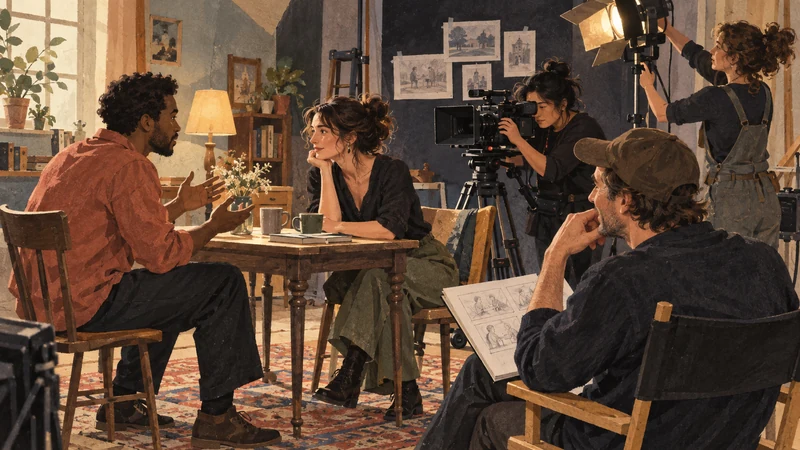
I had imagined the finished masterpiece sitting inside his head, immaculate and complete, awaiting passage through a distressingly inefficient population of other people.
Actors. Editors. Camera operators. Schedules. Budgets. Opinions.
So many opinions!
But what if the masterpiece was not sitting there complete? What if some of it came into existence through those people?
Even the phrase “Guy Ritchie’s show” compresses a collective enterprise into a convenient name. On the first season of The Gentlemen, he was creator, co-writer, executive producer, and director of the first two episodes—not the sole creator of everything we see (Ariana Romero).
Theo James and Daniel Ings described extensive improvisation and collaborative development on the series. They were doing more than faithfully executing a settled script (Patrick Gomez).
This was awkward for my argument. The people I had mentally classified as production complications were apparently helping produce the thing I liked.
An actor’s interpretation might improve the character. An editor might discover a rhythm the director had not anticipated. A disagreement might rescue a scene from its creator’s favourite bad idea.
The sociologist Howard Becker’s Art Worlds offers a useful corrective to the solitary-genius picture: art emerges through cooperative networks and shared conventions, not simply from an individual whose inspiration somehow survives contact with everyone else (Howard S. Becker).
Perhaps being a great director partly means knowing how to create with people whose contributions cannot be specified in advance.
If so, I could not neatly separate his gift for storytelling from his gift for working with people. Working with them might be one of the ways he tells the story.
I also needed to be more careful about what I called a constraint. Bad scheduling, creative disagreement, and a worker’s insistence on consent or fair compensation are not interchangeable obstacles. “Human-first” for the person controlling the production does not automatically mean human-first for everyone else.
None of this makes every meeting sacred. There is no need to establish a museum of preventable logistical failures.
It means only that some friction obstructs creation, while some friction participates in it.
A useful machine should help us tell the difference.
The portrait painter survives, but the job changes
The camera seemed to offer a way through.
Painted likenesses once served some of the practical purposes photographs would later serve. The Victoria and Albert Museum notes that portrait miniatures were popular as portable images of loved ones until the rise of photography in the nineteenth century (Victoria and Albert Museum).
A likeness to carry with you. A face to remember.
But a portrait can do more than establish the arrangement of somebody’s nose. It can interpret, commemorate, flatter, challenge, or communicate how one person sees another.
In 2018, the Smithsonian’s National Portrait Gallery unveiled painted portraits of Barack and Michelle Obama by Kehinde Wiley and Amy Sherald. The institution had not resorted to painting because nobody could locate a photograph of the Obamas (Smithsonian National Portrait Gallery).
The paintings were doing something else. Photography, too, became more than an efficient substitute for painting. As the Metropolitan Museum’s account of Daguerre explains, artistic expression and scientific use were intertwined in photography from its beginnings (Malcolm Daniel).
The new medium did not simply take over the old job. It helped create new jobs for images.
The analogy helps because a technology can separate purposes that had previously travelled together. Capturing a likeness, interpreting a person, demonstrating a craft, and preserving a moment need not all depend on the same method.
A horse does not have to outperform a car to justify an afternoon of riding. Getting somewhere and riding a horse are different purposes, even when they once coincided.
Perhaps AI will produce a similar separation. Entertainment might become plentiful and inexpensive, while particular works remain attractive because of the person who shaped them or the people who performed them together. Entirely new forms might appear that make our current argument about conventional television look quaint.
But the analogy has limits. A generated image of a family reunion that never happened is not a record of a reunion. And the continued existence of painting tells us nothing definite about how large a future market for human-made television would be.
“Paintings still exist” is an observation.
“Therefore, everyone involved in painting will be fine” is a different sentence, generally delivered from a safer line of work.
The machine does not stay downstairs
There is another reason AI may differ from the comforting version of the camera story.
My original fantasy assigned the machine the execution and left the human the vision. Ritchie would decide what to say; AI would handle the expensive business of saying it.
But generative AI can also propose what to say.
It can supply a premise, a character, an exchange of dialogue, an alternative ending. The supposedly protected creative core is not protected merely because we have placed it higher on the organizational chart.
In an experiment involving short stories, Anil Doshi and Oliver Hauser found that access to AI-generated ideas improved evaluations of individual stories, especially for writers with lower baseline creativity. Yet the AI-assisted stories also became more similar to one another: in this experiment, better individual results came with less collective variety (Anil Doshi and Oliver Hauser).
That is not a prophecy about every future film. It is a warning against assuming that giving everyone more expressive power automatically produces a more varied culture.
My imaginary Ritchie could escape one set of constraints and inherit another: the suggestions, defaults, and tendencies of his tools. Much would depend on whether he used them to sharpen his sensibility or gradually let them stand in for it.
But suppose the tools became extraordinarily good. Suppose they could offer compelling stories, surprising images, even the sort of criticism we associate with talented collaborators.
Would that make human participation pointless?
Only if something must be exclusively human to be valuable to humans.
That strikes me as a peculiar requirement. I do not need to establish that conversation is beyond the reach of all possible machines before enjoying a conversation with my wife.
The value of participating in an activity is not necessarily a medal awarded for defeating every available alternative.
Fundamental to us does not have to mean impossible for anything else.
We need not keep defending an ever-shrinking list of tasks the machines supposedly cannot do. We can ask:
What do we actually want to do?
The human-first-principles machine
I began to think of AI as a human-first-principles machine. By making previously necessary work optional, it could force us to examine why we were doing that work in the first place.
That possibility interests me more than labour-saving alone, or an entertainment factory operating at a speed that makes human attention look like a manufacturing defect.
Suppose I am writing software. Am I trying to solve someone’s problem? Understand a system? Exercise a craft? Experience the satisfaction of making an elegant thing? Depending on the project, I might be pursuing all of these at once.
A tool that helps me deliver a solution could serve the first purpose beautifully. A tool that does all the thinking while I approve its output might do less for the others.
Likewise, cooking dinner can mean producing food, caring for someone, practising a skill, or enjoying an hour in the kitchen. The same person can regard chopping onions as a pleasure on Saturday and an administrative outrage on Tuesday.
There is no contradiction. The purpose has changed.
Psychologists Michael Inzlicht, Amitai Shenhav, and Christopher Olivola describe an “effort paradox”: people often avoid effort, yet it can also contribute to an activity’s value. Sometimes people choose an activity precisely because it demands effort. Difficulty is not invariably a defect awaiting removal (Michael Inzlicht et al.).
This does not mean drudgery is character-building by definition. A malfunctioning printer is not a spiritual practice.
It means that eliminating effort and improving an experience are different objectives.

Richard Ryan and Edward Deci’s self-determination theory identifies autonomy, competence, and relatedness as basic psychological needs: acting willingly, developing and exercising capability, and connecting with others. In my thought experiment, a production process might meet several of these needs. Control over the finished film would be only part of what it offered (Richard Ryan and Edward Deci).
AI could increase a filmmaker’s autonomy while changing the role of craft or collaboration. It could help someone acquire a skill or make it easier to avoid acquiring it. These are possibilities to examine, not inevitable effects.
For Ritchie, the fundamental purpose might indeed be telling stories in his own way. Perhaps AI would allow him to concentrate on that more fully.
For an actor, the point might be inhabiting a character. For a viewer, it might be watching the encounter between those two people. What each values as the human element need not be the same.
I had been looking for one essential human contribution, as though we could find it by stripping everything else away. AI would instead present us with choices that necessity had previously made on our behalf.
Once I no longer have to do this, do I still want to?
Once someone else no longer has to participate, do I still value their participation?
And whose freedom am I increasing?
In The Turing Trap, Erik Brynjolfsson argues that using AI to extend people’s capabilities and using it to substitute for them can distribute opportunity and power differently. Which path we favour depends partly on how we design and deploy the technology and what the incentives reward (Erik Brynjolfsson).
The attractive future, to me, is not one in which every activity has been optimized until nobody needs to participate.
It is one in which we can surrender more of the work we do merely to get somewhere, while gaining more room for the work—and play, and relationships—we would choose even after we arrived.
Hundreds of episodes. Still only one evening.
What, then, had I been offering with my magnificent proposal for hundreds of episodes?
More television, certainly. More good television, not necessarily. More meaningful human experience, still to be determined.
Even in my imagined future, authorship would still demand substantial creative judgement. A filmmaker who could generate alternatives quickly would still have to decide which ones belonged in the story.
And my wife and I would still have to watch.
A hundred episodes would not provide us with a hundred evenings. It would provide us with another way to spend the evenings we already had.
The more exciting possibilities might not involve extending familiar shows indefinitely. Perhaps people with no access to conventional production budgets could make films worth seeing. Perhaps we would develop interactive stories or forms of shared creation that do not fit comfortably into the category of an episode.
I find that prospect thrilling. I do not want to defend every existing production constraint merely because something beautiful once emerged within it.
Nor do I want to confuse the survival of a practice with the security of its practitioners. Acemoglu and Restrepo’s research on automation distinguishes the displacement of existing human tasks from the creation of new ones. Productivity gains alone do not settle what happens to demand for people’s work (Daron Acemoglu and Pascual Restrepo).
A future in which human craft becomes a freely chosen pleasure would be very different from one in which it survives only as an underfunded hobby. “People will still make things” is not an adequate answer to every economic question.
But neither is uncertainty a reason to pretend the new possibilities have no value.
I can imagine wanting a film made with AI because its creator has something extraordinary to show me, and a conventional production because the performances and collaboration are inseparable from what I admire. I could enjoy both without requiring a committee to resolve my inconsistency.
My wife and I did not arrive at a final verdict. She remained more drawn to the human production. I remained excited about the possibility of giving a storyteller more freedom.
I no longer saw those preferences as enemies.
I had started by picturing a machine that could give us more Guy Ritchie. I ended up thinking about what it was we had enjoyed: a story, performances, a sensibility, and the experience of watching something together and then disagreeing about it.
That last part had proved surprisingly productive.
Perhaps this is one of the most useful things AI will do. By making more things possible without our participation, it will make us more deliberate about the places where our participation matters.
AI may remove the necessity of doing something ourselves.
It cannot tell us whether doing it ourselves was the point.
References
- Kory Mathewson. “Behind ‘ANCESTRA’: combining Veo with live-action filmmaking.” Google DeepMind, 2025.
- Lucas Bellaiche et al. “Humans versus AI: whether and why we prefer human-created compared to AI-created artwork.” Cognitive Research: Principles and Implications, 2023.
- Brian Porter and Edouard Machery. “AI-generated poetry is indistinguishable from human-written poetry and is rated more favorably.” Scientific Reports, 2024.
- Ariana Romero. “The Gentlemen Is Bringing the Swagger: Inside Guy Ritchie’s New Show.” Netflix Tudum, 2024.
- Patrick Gomez. “The stars of Netflix’s The Gentlemen improvised a lot more of Guy Ritchie’s series than you may think.” Entertainment Weekly, 2024.
- Howard S. Becker. Art Worlds. University of California Press, 1982; anniversary edition, 2008.
- Victoria and Albert Museum. “How was it made? Portrait miniatures.”
- Smithsonian National Portrait Gallery. “Presidential Portraits Unveiled Feb. 12, 2018.”
- Malcolm Daniel. “Daguerre (1787–1851) and the Invention of Photography.” Metropolitan Museum of Art, 2004.
- Anil R. Doshi and Oliver P. Hauser. “Generative AI enhances individual creativity but reduces the collective diversity of novel content.” Science Advances, 2024.
- Michael Inzlicht, Amitai Shenhav, and Christopher Y. Olivola. “The Effort Paradox: Effort Is Both Costly and Valued.” Trends in Cognitive Sciences, 2018.
- Richard M. Ryan and Edward L. Deci. “Self-determination theory and the facilitation of intrinsic motivation, social development, and well-being.” American Psychologist, 2000.
- Erik Brynjolfsson. “The Turing Trap: The Promise & Peril of Human-Like Artificial Intelligence.” Daedalus, 2022.
- Daron Acemoglu and Pascual Restrepo. “Automation and New Tasks: How Technology Displaces and Reinstates Labor.” Journal of Economic Perspectives, 2019.