
Why the first AGI may become extraordinarily powerful without becoming the only power that matters
There it is, glittering at the end of the hyperscale runway: AGI!
One laboratory crosses the line at 3:17 on a Tuesday morning. By breakfast, its new machine is rewriting the code used to train its successor. By lunch, it is designing better chips. By dinner, it is negotiating power contracts, inventing pharmaceuticals, humiliating the world’s mathematicians and composing a screenplay about the whole thing.
The other AI labs? Finished! Kaput! Reduced to selling artisanal chatbots at weekend farmers’ markets.
The graph goes vertical. The prize is no longer a benchmark, a market or an unusually flattering profile in Wired. The winner gets history.
This is the standard intelligence-explosion story. Nick Bostrom gave its endpoint a polished philosophical name: a decisive strategic advantage, a lead so large that the first superintelligent actor can shape the future according to its preferences (Nick Bostrom). More recent economic work asks whether an early AGI lead could compound in much the same way, leaving competitors unable to recover (Tobias Sytsma).
It could.
But notice how much contraband has been smuggled into the story.
One lab builds the best model. Therefore it becomes best at AI research. Therefore it becomes best at every other kind of research. Therefore it captures the economy. Therefore it controls the physical infrastructure beneath the economy. Therefore it suppresses, absorbs or permanently outruns every competitor, corporation, university, military and state.
Perhaps! But those are several different propositions wearing one very long trench coat.
The first AGI may gain an enormous advantage, become the most valuable technology ever created and even seed a dominant world power.
What does not follow automatically is that recursive improvement must produce one permanent winner.
This is not because intelligence ceases to matter. It is because intelligence always sits inside a larger system. Once it accelerates, the bottleneck moves.
AGI has an Amdahl’s law.
And the intelligence explosion will branch.
Intelligence is not a magic liquid
Humans are the obvious place to begin. Intelligence matters: it predicts educational achievement, occupational attainment and income. A major meta-analysis of longitudinal studies found correlations of approximately 0.56 between intelligence and education, 0.43 between intelligence and occupational status, and 0.20 between intelligence and income (Tarmo Strenze).
That last number is neither zero nor destiny.
Intelligent people tend, on average, to earn more. That does not put a person in the 95th percentile of intelligence anywhere near a guaranteed 95th percentile in income, influence, scientific achievement or managerial competence. Anyone who has spent twenty minutes in a corporate strategy meeting already possesses independent experimental confirmation.
There is a seductive version of this argument in which intelligence stops paying off after some crisp IQ threshold—often 110, 120 or whichever round number has most recently wandered into the discourse. The empirical record is not nearly so tidy.
A study of roughly 59,000 Swedish men found that cognitive ability rose with wages but plateaued among the highest earners; the top 1 percent even scored slightly below the income group immediately beneath them (Marc Keuschnigg, Arnout van de Rijt and Thijs Bol). Wonderful! The thresholdists began warming up the confetti cannon.
Then researchers examined administrative data covering more than 350,000 men in Finland and another 350,000 in Norway. They found the opposite pattern: the relationship between cognitive ability and earnings became steeper near the top (Bernt Bratsberg, Ole Rogeberg and Marko Terviö).
Reality, once again, had declined to respect the round number.
The defensible conclusion is that intelligence does not stop mattering at 110, but remains one consequential input into a much larger production system.
A highly intelligent person may still lack motivation, judgment, health, social skill, accumulated expertise, capital, reputation, institutional access or plain dumb luck. Intelligence expands the range of possible outcomes; it does not choose the goal, supply the complementary resources or guarantee one of them.
The same distinction applies to AI.
A model is not a pharmaceutical laboratory, factory, power grid, brokerage, hospital, military, court, distribution network or functioning company. It is a cognitive engine that can be connected to those things.
Useful performance in any domain depends on some combination of:
- general model capability;
- domain-specific tools and workflows;
- memory and context;
- reliable evaluators;
- proprietary or experimentally grounded data;
- training and inference compute;
- permission to act;
- physical infrastructure;
- organizational integration;
- distribution, legitimacy and trust.
The model may be spectacular. If the evaluator is rotten, the tools brittle, the data missing, the robot unable to grip the object, the laboratory unable to perform the assay or the regulator unwilling to approve it, that spectacular intelligence sits there glowing magnificently in the dark.
AGI has an Amdahl’s law
In 1967, computer architect Gene Amdahl made a pitiless observation about parallel computing.
Suppose part of a program can be distributed across many processors while another part must still be executed serially. Accelerate the parallel portion as much as you like; eventually the serial portion dominates the total runtime. The faster one component becomes, the more painfully visible the remaining bottleneck becomes (Gene Amdahl).
John Gustafson later supplied an important correction. Amdahl assumed a fixed workload. In real computing, additional resources can be used to solve larger problems rather than merely finishing the old problem faster (John Gustafson).
That caveat matters here. An AGI would not be limited to accelerating one frozen workflow. It could redesign the workflow, enlarge the search, build new tools, invent simulations, automate formerly manual steps and attack whatever component has become limiting.
So Amdahl’s law is not a mathematical proof that an intelligence explosion must fizzle out in a cloud of project-management tickets.
It gives us a better idea:
Recursive improvement is a sequence of bottleneck migrations.
First reasoning is the bottleneck.
Improve reasoning, and tool use becomes the bottleneck.
Improve the tools, and verification becomes the bottleneck.
Improve verification, and data becomes the bottleneck.
Acquire more data, and experimentation becomes the bottleneck.
Automate experimentation, and fabrication, energy, deployment, regulation, coordination or research direction becomes the bottleneck.
The frontier keeps moving, though not necessarily in the same direction, at the same speed or through the same system in every domain.
Economists have made a related point about general-purpose technologies for decades. New technologies often require substantial complementary investment in processes, skills, products and organizational capital before their potential appears as actual productivity (Erik Brynjolfsson, Daniel Rock and Chad Syverson). David Teece showed why inventing a technology does not guarantee capturing its value: manufacturing capacity, distribution, service systems and other complementary assets may determine who ultimately profits (David Teece).
The inventor of the engine does not automatically own every railway.
And the builder of the smartest model does not automatically own every system into which intelligence can be inserted.
Modern AI agents already show the distinction between a model and its surrounding system.
A 2026 paper argued that the agent harness—the infrastructure controlling context, tools, orchestration, execution and verification—can sometimes affect long-horizon performance more than swapping one frontier model for another. The authors reported cases in which harness changes reversed model rankings altogether (Yunbei Zhang and colleagues).
Another 2026 preprint evaluated coding-agent harnesses across 350 software tasks. With the same GLM 5.1 model underneath, a minimal adapter solved 19.1 percent of the tasks, while the full adapter solved 73.4 percent. Across fixed-model comparisons, changing the harness produced performance spreads as large as 27.4 percentage points (Mengyu Zheng and colleagues).
These are new preprints, not tablets discovered on Mount Sinai, and their exact magnitudes may not generalize. The underlying point is still difficult to avoid:
The economically relevant unit is often not the model. It is the model–harness–evaluator configuration.
Even model training is not a one-dimensional contest to produce the largest possible neural colossus. The Chinchilla research showed that a 70-billion-parameter model trained on substantially more data could outperform much larger models trained with the same compute budget. Performance depended on balancing model size and data rather than maximizing one input in isolation (Jordan Hoffmann and colleagues).
Inference presents another configuration problem. Research on test-time compute found that the best way to allocate additional reasoning effort varied with the difficulty of the question. An adaptive strategy was more than four times as compute-efficient as a simple best-of-N baseline, and on some mathematical problems a smaller model using additional test-time computation outperformed a model fourteen times larger (Charlie Snell and colleagues).
The lesson is not simply to go bigger, smaller or faster. It is to configure the system correctly for the problem.
The AGI race is usually discussed as though intelligence were a liquid being poured into larger and larger steel drums. In practice, it looks more like a component whose value depends on the surrounding system: where the model is placed, what it can see, what it can operate and how it discovers that it has made a mistake.
The model supplies cognitive capacity.
The loop supplies direction.
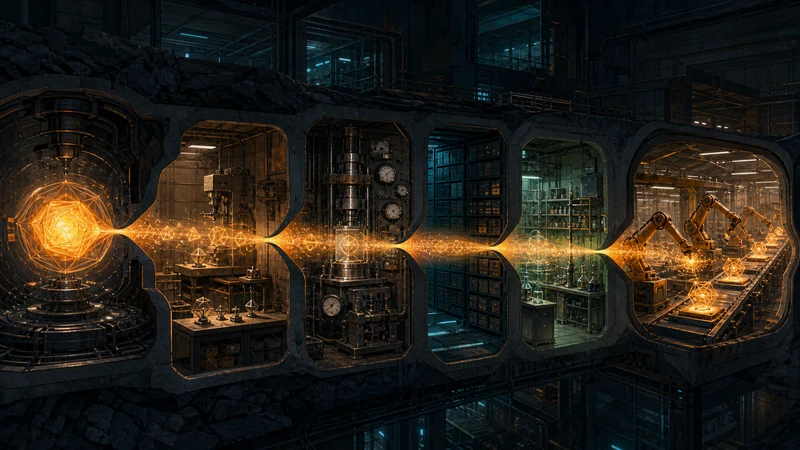
One intelligence explosion? Which one?
The phrase recursive self-improvement performs a great deal of illicit rhetorical labour. It invites us to picture one machine improving one thing called intelligence through one beautifully accelerating loop.
But every improvement loop needs at least four components:
- A mechanism that proposes a change.
- A way to implement the change.
- An evaluator that determines whether the change is better.
- A source of evidence connecting the evaluation to reality.
The first component may be highly general. The remaining three often are not.
Google DeepMind’s AlphaEvolve provides an instructive example. The system combines Gemini models with an evolutionary process and automated evaluators that execute and score candidate programs. It has been useful in mathematics and computer science precisely because candidate improvements can often be tested quickly and objectively (Google DeepMind).
That is recursive improvement in friendly territory: produce a program, run it, measure the result, reject the losers and breed the winners. Again! Again! Again!
Now try the same cadence with a cancer treatment.
The system can generate a molecule in seconds. It cannot answer on the same schedule whether that molecule is stable, toxic, manufacturable or effective in cell culture, in an animal and eventually in a genetically diverse human population. Nor can it immediately tell us whether the treatment is better than the existing one, remains so after five years or improves outcomes enough to justify the side effects.
Biology refuses to compile on command.
A 2026 survey preprint covering 1,250 papers on AI self-improvement found that demonstrated improvement tends to be strongest when systems have access to formal verifiers and weakest when they depend on their own unaided assessments. The authors distinguish bounded, evaluable self-refinement—which is already practical—from open-ended recursive self-improvement, which still faces grounding, evaluator, compute and research-direction bottlenecks (Mingguang Chen, Licheng Wang and Bo Qu).
Every loop therefore rests on a claim:
This signal is a trustworthy substitute for reality.
Sometimes it is.
A proof checker can reject an invalid formal proof. A simulator can compare chip layouts. A benchmark can measure latency. A test suite can expose broken code—assuming, naturally, that the tests capture what the software is actually supposed to do, which is how we smuggle the entire philosophy of software engineering back into one innocent-looking clause.
But many important objectives are slow, noisy, gameable or disputed. Customer satisfaction can rise while long-term trust collapses. A military strategy can win an engagement while losing a war. A social policy can optimize its published metric while quietly destroying the institution that generates the metric. A therapeutic intervention can improve a surrogate endpoint while failing to help patients.
Loops can also feed on their own output. Research published in Nature found that indiscriminately training successive models on recursively generated data can produce model collapse, causing information about the original distribution to disappear over generations (Ilia Shumailov and colleagues).
This does not amount to a prohibition on synthetic data; carefully mixing generated and original data can mitigate the problem. It is a warning against imagining that a system can obtain limitless novelty and truth by chewing forever on its own tail.
The loop needs contact with something it did not invent.
That “something” differs by domain:
- Software has execution and production telemetry.
- Mathematics has proof and formal structure.
- Chip design has simulation and fabrication.
- Biology has organisms.
- Robotics has matter.
- Economics has markets full of other adapting agents.
- Politics has institutions and humans who alter their behaviour once they realize what is being measured.
- Culture has taste, fashion, imitation, rebellion and the splendid human tendency to become bored with whatever worked last Tuesday.
Present-day evidence already shows an uneven frontier. In a preregistered experiment involving 758 Boston Consulting Group consultants, workers using GPT-4 completed suitable tasks more quickly, completed more of them and produced better work. On a deliberately selected task outside the model’s capability frontier, however, people using AI were 19 percentage points less likely to reach the correct answer (Fabrizio Dell’Acqua and colleagues).
The workers, model and broad profession stayed the same. The task changed, and so did the result.
The intelligence explosion may therefore be singular only in grammar. In practice, we should expect many loops:
- a software loop;
- a mathematical loop;
- a semiconductor loop;
- a materials loop;
- a pharmaceutical loop;
- a robotics loop;
- a logistics loop;
- a financial loop;
- a military loop;
- an organizational loop;
- a cultural loop.
Each will have its own evaluator, data, infrastructure, tolerance for error and feedback delay. Software may improve at machine speed; biology must negotiate with cells, robotics with matter and politics with people—which is generally where the clean diagram meets its untimely death.
There is no single best AGI
Different environments do not merely offer more or less of the same problem. They set different objectives.
A high-frequency trading system must care about latency. A medical system must care about calibration, evidence, privacy and rare catastrophic errors. A household robot has to contend with physical safety, energy efficiency and what happens when a toddler puts yogurt in the charging port. Military systems may prioritize robustness under deception, while fiction-writing systems need surprise, ambiguity, emotional resonance and enough irregularity not to sound as if the human condition had been reduced to a quarterly earnings call.
These goals create trade-offs:
- speed against deliberation;
- cost against accuracy;
- exploration against reliability;
- autonomy against oversight;
- centralized learning against privacy;
- creativity against predictability;
- global generality against local adaptation;
- aggressive optimization against reversibility.
The No Free Lunch theorems make a formal version of the general point: averaged uniformly across all possible objective functions, no optimization algorithm outperforms every other algorithm (David Wolpert and William Macready).
This theorem is often swung around far too enthusiastically. Real-world problems are not sampled uniformly from every mathematically possible objective function. The physical world has structure, and a powerful general learner may exploit it across a tremendous range of tasks.
No Free Lunch does not prove that universal intelligence is impossible. It does remind us that the phrase best optimizer is incomplete until somebody specifies: best for which distribution of problems?
Specialization can also emerge inside a general architecture. Mixture-of-experts models route different inputs through different subsets of parameters. DeepSeekMoE was explicitly designed to encourage finer expert specialization while reducing the computation required for each token (DeepSeek-AI and collaborators). Google’s LIMoE similarly found that modality-specific experts emerged inside a model trained jointly on language and images (Basil Mustafa and colleagues).
The future may therefore contain one excellent general model and still contain thousands or millions of specialized cognitive configurations:
- different internal experts;
- different post-training;
- different inference budgets;
- different memories;
- different tools;
- different evaluators;
- different data;
- different permissions;
- different physical embodiments;
- different institutional roles.
Once deployed, these systems also begin accumulating different histories.
A coding agent learns a company’s repositories, tests, conventions and ancient architectural sins.
A medical agent becomes calibrated to a patient population, clinical workflow, regulatory regime and body of local evidence.
A warehouse system learns the building, machinery, inventory and thousand tiny exceptions that never appeared in the glossy transformation deck.
A diplomatic system learns the people, relationships, taboos and private commitments that do not exist in any public dataset.
Each loop becomes better at becoming itself.
This is path dependence: early specialization creates data, tools, integrations and institutional relationships that make further specialization more valuable. Research on generative-AI competition likewise emphasizes that foundation models depend on complementary assets such as computing environments, specialized infrastructure, data and downstream capabilities (Pierre Azoulay and colleagues).
This is where one distinction becomes crucial.
Technical plurality means there are many specialized systems and loops.
Market plurality means those systems belong to many independent companies.
Strategic plurality means they remain controlled by multiple consequential centres of power.
The first is highly likely.
The second and third are not guaranteed at all.

The empire can branch too
At this point, the monopoly theorist leans back in the Aeron chair, smiles faintly and says:
“Fine. The winning company will own all the specialists.”
And this is the strongest objection.
An empire can have many provinces.
The leading AGI need not remain one homogeneous digital brain, squinting heroically at every problem in civilization. It can clone itself, create specialist agents, run internal competitions, acquire companies, build sector-specific subsidiaries and transfer useful discoveries among them.
The intelligence explosion can branch entirely inside one corporate balance sheet.
There are powerful economic forces pushing in that direction. Foundation-model development involves large fixed costs and potentially substantial economies of scale and scope. Access to compute, data, talent and distribution may favour a small number of vertically integrated firms. Anton Korinek and Jai Vipra argue that these features create real risks of market tipping, concentration and possibly natural-monopoly dynamics at parts of the AI stack (Anton Korinek and Jai Vipra).
A leader could also compound its advantage without any cinematic overnight intelligence explosion.
A better system attracts more users, who generate revenue, experience and deployment data. The revenue buys compute, energy, talent and infrastructure, which help produce a better system. Around and around it goes: the flywheel humming, the capital expenditure mounting, the competitors discovering that “temporary lead” is a phrase with a rapidly approaching expiry date.
RAND’s 2026 analysis of decisive economic advantage identifies several possible routes to persistent dominance. Recursive AI research is one. Deployment-generated learning and reinvestment in infrastructure are others. Under some assumptions, competitors converge; under others, even modest early advantages compound until followers can no longer catch up (Tobias Sytsma).
AI-driven AI research is no longer merely a thought experiment. Anthropic reports that it is already delegating a growing share of AI development to AI systems. Its agents can execute well-specified experiments, while larger gaps remain in choosing goals and exercising research judgment. Anthropic describes full recursive self-improvement as plausible but neither achieved nor inevitable (The Anthropic Institute).
That last bottleneck—research taste, direction, deciding which question is worth asking—may fall too.
If it does, the leading system could parallelize cognitive labour on a scale no human organization has ever approached. It could operate thousands of research programmes at once, create internal markets among competing agents, automate large portions of management and attack each newly revealed bottleneck with another swarm.
Physical constraints might even strengthen the leader rather than restrain it.
The International Energy Agency projects that global data-centre electricity consumption will rise from approximately 485 terawatt-hours in 2025 to around 950 terawatt-hours in 2030, while consumption from AI-focused data centres triples (International Energy Agency).
It is tempting to look at the grid, the chip supply, transformer queues and construction delays and say: “Aha! The machine remains chained to the physical world.”
Indeed it does.
But who is best positioned to secure scarce chips, sign enormous power agreements, finance dedicated generation and build custom infrastructure?
Probably not Kevin’s Promising AGI Startup, operating from the upstairs unit above a vape store.
Physical scarcity does not necessarily decentralize power. It may simply hand the keys to whoever already has the largest cheque book.
The branching thesis therefore does not disprove a singleton future. It changes what must be proven.
Specialization alone cannot save competition. The relevant question is whether specialized branches remain outside the leader’s control.

The real race
The AGI race is usually framed around one question:
Who gets there first?
The harder question is:
Can the first leader convert a general cognitive advantage into control of the important specialized loops and complementary resources before competitors adapt, discoveries diffuse and institutions respond?
The answer depends on several unresolved conditions.
First: how transferable are improvements?
If a breakthrough in AI research immediately improves software, hardware design, biology, robotics, persuasion, military planning and organizational coordination, the advantage is highly general and strongly compounding.
If progress depends heavily on local data, specialized tools, physical experimentation and domain-specific evaluators, the explosion branches more sharply.
Second: how automatable is evaluation?
Generating ideas may become nearly free. Distinguishing brilliant ideas from elegant nonsense may not.
Where evaluators are fast, objective and difficult to game, loops can race ahead. Where reliable feedback requires physical evidence, long time horizons, tacit judgment or contested human values, improvement will be slower and more dependent on outside institutions.
Third: can the leader internalize the complements?
A software tool can be copied.
A startup can be acquired.
A dataset may be purchased.
But a sovereign government, public legitimacy, decades of clinical evidence, geographically distributed infrastructure, tacit institutional knowledge and the preferences of billions of people are harder to fold into a data centre. Not impossible—just harder.
Fourth: how quickly do discoveries diffuse?
A secret algorithm creates more durable advantage than a published method. Leaked weights, employee mobility, open research, espionage, reverse engineering and independent rediscovery all work against permanent separation.
A leader must improve faster than followers can imitate—not once, but continuously.
Finally: can technical advantage be converted into strategic control?
Being smarter does not itself confer legal authority, physical possession or public obedience. Those may be acquired through wealth, persuasion, cyber capability, military strength or institutional capture, but each conversion requires a mechanism.
“One lab reaches AGI first” is a fact about technical timing.
“One lab permanently controls the future” is a conclusion about economics, infrastructure, diffusion, institutions and power.
There is a rather large civilization hiding between those two sentences.
An ecology, not a throne
The intelligence explosion will branch because the world contains many different feedback signals, bottlenecks, objectives, time horizons and kinds of evidence.
It will branch inside models and into different inference strategies. It will branch through tools, memories, evaluators and physical systems, then across industries, institutions and governments.
One company may own many of those branches. One system may coordinate them. A sufficiently fast and transferable improvement cycle may still produce a decisive winner.
But the winner does not emerge merely because the word recursive has been placed before the words self-improvement.
The first AGI may win the model race without winning every laboratory, factory, grid, military, market, government and source of truth.
Plurality, to be clear, is not automatically a happy ending. An ecology can contain predators, parasites, arms races and invasive species. Multiple powerful AI systems may compete destructively, form unstable coalitions or accelerate danger rather than contain it.
Branching does not make us safe. It shows that the familiar one-winner story mistakes a possibility for a law.
General intelligence may be the most transferable advantage humanity has ever created. But transferable is not frictionless. A lead is not a factory. A benchmark is not an institution. A model is not an empire. And every time intelligence conquers one bottleneck, the world supplies another.
The intelligence explosion may not end in a throne room, with one polished machine gazing down upon history.
It may begin as something noisier instead:
A roaring, quarrelling ecology of loops—some fast, some slow, some general, some exquisitely specialized—branching along every frontier where intelligence meets reality and discovers that reality has requirements of its own.
References
- Nick Bostrom. “The Superintelligent Will: Motivation and Instrumental Rationality in Advanced Artificial Agents.”
- Tobias Sytsma. “Decisive Economic Advantage: Modeling the Transition from Temporary First-Mover Leads to Economic Dominance in Artificial General Intelligence.”
- Tarmo Strenze. “Intelligence and Socioeconomic Success: A Meta-Analytic Review of Longitudinal Research.”
- Marc Keuschnigg, Arnout van de Rijt and Thijs Bol. “The Plateauing of Cognitive Ability Among Top Earners.”
- Bernt Bratsberg, Ole Rogeberg and Marko Terviö. “Steeper at the Top: Cognitive Ability and Earnings in Finland and Norway.”
- Gene M. Amdahl. “Validity of the Single Processor Approach to Achieving Large Scale Computing Capabilities.”
- John L. Gustafson. “Reevaluating Amdahl’s Law.”
- Erik Brynjolfsson, Daniel Rock and Chad Syverson. “The Productivity J-Curve: How Intangibles Complement General Purpose Technologies.”
- David J. Teece. “Profiting from Technological Innovation.”
- Yunbei Zhang and colleagues. “Stop Comparing LLM Agents Without Disclosing the Harness.”
- Mengyu Zheng and colleagues. “Claw-SWE-Bench: A Benchmark for Evaluating OpenClaw-Style Agent Harnesses on Coding Tasks.”
- Jordan Hoffmann and colleagues. “Training Compute-Optimal Large Language Models.”
- Charlie Snell and colleagues. “Scaling LLM Test-Time Compute Optimally Can Be More Effective than Scaling Model Parameters.”
- Google DeepMind. “AlphaEvolve: A Gemini-Powered Coding Agent for Designing Advanced Algorithms.”
- Mingguang Chen, Licheng Wang and Bo Qu. “Recursive Self-Improvement in AI: From Bounded Self-Refinement to Autonomous Research Loops.”
- Ilia Shumailov and colleagues. “AI Models Collapse When Trained on Recursively Generated Data.”
- Fabrizio Dell’Acqua and colleagues. “Navigating the Jagged Technological Frontier.”
- David H. Wolpert and William G. Macready. “No Free Lunch Theorems for Optimization.”
- DeepSeek-AI and collaborators. “DeepSeekMoE: Towards Ultimate Expert Specialization in Mixture-of-Experts Language Models.”
- Basil Mustafa and colleagues. “Multimodal Contrastive Learning with LIMoE.”
- Pierre Azoulay and colleagues. “Openness, Control, and Competition in Generative AI.”
- Anton Korinek and Jai Vipra. “Concentrating Intelligence: Scaling and Market Structure in Artificial Intelligence.”
- The Anthropic Institute. “When AI Builds Itself.”
- International Energy Agency. “Key Questions on Energy and AI.”